World Cup Day 20: On The Margins Of The Game

Day 19 at the World Cup delivered a few takeaways we will carry with us into the 12 remaining matches set for the first-ever Round of 32 and beyond into the Round of 16, quarterfinals, and so on:
- Soccer is a game of fine margins that often comes down to individual moments in a match featuring thousands and thousands of decisions over 90 minutes, 120 minutes, or 120 minutes plus penalties.
- Resolute defensive soccer can frustrate even the most talented players and give "lesser" teams a fighting chance.
- Penalties are cruel and unusual but remain the highest form of drama created by man.
- The entire sport of association football might be a devious torture device creating by English public school lads as a cruel joke on the world.
Let's take these one-by-one:
Soccer is a game of fine margins that often comes down to individual moments in a match featuring thousands and thousands of decisions over 90 minutes, 120 minutes, or 120 minutes plus penalties.
It was impossible not to think about the fine margins inherent in how soccer games are won or lost watching three fraught knockout games in Houston, Boston, and Monterrey on the second day of Round of 32 matches.
In the aftermath of a result, we're all guilty of reverse-engineering the reasons for why Team A won and Team B lost. Our brains want to understand, to assign "good" and "bad" labeling to elements of the narrative to better process the an incredibly complex series of events.
Nowhere in this World Cup has that been on starker display than in the discussion around Japan's loss to Brazil compared to Paraguay's triumph over Germany. Despite Japan playing Brazil to a standstill for more than 90 minutes, Gabriel Martinelli's injury time goal shifted the story from one of Japanese effectiveness against the mighty Brazilians to one of waning Japanese courage over the course of 90 minutes.
Without Tanaka's turnover, Bruno Guimaraes's pass, Martinelli's opportunistic take, Japan likely gets to extra time. From there, it's impossible to know if Brazil might have put the Blue Samurai to the sword or if Japan could have mustered more resolve. We can look at that final goal sequence and divine that it means Brazil was "better" or Japan was "deficient" but that feels like a lot of value to ascribe to a series of events that comes from one mistake.
I'm not saying that Brazil didn't deserve to win the game or that Japan couldn't have done a few things better to give themselves a better chance to advance; I'm simply saying the incredibly fine margins make grand proclamations ridiculous on their face.
Maybe this is better expressed like this:
If Japan defend 1 of those goals better & do what Paraguay did by beating Brazil in penalties, it’s praised. But since they lost 1-2 in regulation, they were cowards. I don’t care too much for that kind of grass-is-greener analysis which is super prevalent!
— world cupmaxxing (@dparks.world) June 29, 2026 at 7:55 PM
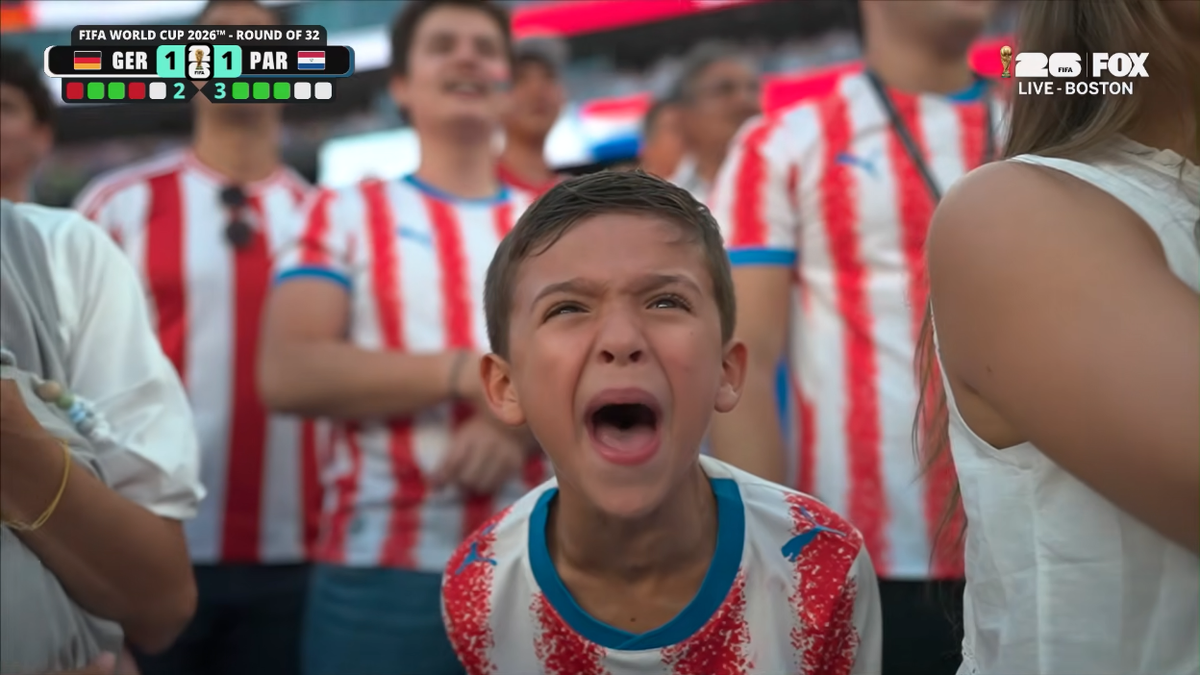
Today the world is celebrating Paraguay (and tearing down Germany) because Orlando Gill made the extra save and Germany's winning goal was taken off the board because of a World Cup-specific emphasis on limiting physical play in the box on corner kicks. That's it. The South American triumph over the famous European side (again, not saying it was not deserved) probably doesn't happen without the reaction to set piece meatwallery across the Premier League and other competitions this last season. If that's not the definition of "fine margins", I don't know what is.
Resolute defensive soccer can frustrate even the most talented players and give "lesser" teams a fighting chance.
I'm not breaking news with this one, but this tournament in particular is bringing to the fore a return to bunkered defending as a default approach in the knockout rounds (of course, we also saw it work in the group phase for Cabo Verde and others). All three matches on Monday featured one team choosing to cede possession, defend in organized lines, and look for counterattacking opportunities to score goals: Japan, Paraguay, and the Netherlands (Total Football has been dead).
I don't have data on this, but the trend—at least to me—speaks to a general rise in professionalism across the global league, the quality of coaching for even the smallest nations, and the impact of better/tighter/more accessible scouting network (especially as it pertains to multi-nationals).
Penalties are cruel and unusual but remain the highest form of drama created by man.
It's a little weird how much I love penalties as someone who struggles with secondhand embarrassment in television and movies. I definitely don't have a handle on the psychology at work (other than I'm just a weirdo), but my guess is that sports exists in a different space in my brain for these things.
I know there are good arguments for why penalties are a terrible way to decide who wins a soccer match, particularly when the stakes are wrapped up in national identity at the World Cup, but I'm not sure any of the imagined fixes would be better.
The Golden Goal had its moment and while there's plenty of logic in "next goal wins" as a means to break a 90-minute tie, the nature of a sport with running play and exhausted players attempting to cover vast amounts of space means the inclination is toward risk mitigation and sudden death (emphasis on "death") can only be so effective.
If you didn't stay up late to watch Morocco triumph on penalties over the Netherlands, do yourself a favor and pull up the penalty shootout on YouTube. It's one of the more remarkable examples of the phenomenon I've ever seen.
we saw two misses wide left, a doink, a standing one-handed swat save, and a gk fish flop himself into an own goal — funniest pk shootout i've seen in a very long time lmao
— andré (@andre-carlisle.bsky.social) June 30, 2026 at 12:06 AM
The entire sport of association football might be a devious torture device creating by English public school lads as a cruel joke on the world.
The drama that unfolded in Monterrey at the end of the Netherlands v. Morocco match, first via Cody Gakpo's go-ahead goal (an emotional moment for Gakpo, whose partner announced the death of their unborn son over the weekend) and Issa Diop's "large centerback plays forward in the desperate final moments" equalizer and then in penalties, was preceded by a brutal, physical 70-plus minutes that saw multiple bleeding incidents and the type of tackle-with-murderous-intent tackles that felt like a nod to soccer's more rough-and-tumble past.
This, naturally, led to the type of self-flagellation that only soccer fans can conjure while watching their favorite sport. People whose entire lives revolve around the game tapped a portion of their finite well of earthly energy to moan and howl about how terrible our game really is.
Myself included, of course. If the internet has done nothing else—and I can't really think of anything worth mentioning—it has created a beautiful, maddening, twisted, and hilarious culture of dislocated collective viewing that leads to the sharing of pain when two teams put us in the torture device of the beautiful game.
Because of course, it is beautiful. It's the pain and the suffering (relatively speaking) that make the moments of inspiration all the better. I'll come back to this: the pure volume of events in a soccer match serve as the blackest of backdrop to allow the explosions of light that come every so often stand out all the more.
It's torture until it's not. And when it's not, there's nothing in this world that can match it.
PROGRAMMING NOTES
I'll be on the radio (SiriusXM FC Channel 157) from 7-10 PM ET with Eric Wynalda to talk about the Round of 32 matches from the day and preview the USMNT's clash with Bosnia & Herzogovina on Wednesday.