Invasion


Guess who's back to try again.
 Associated Press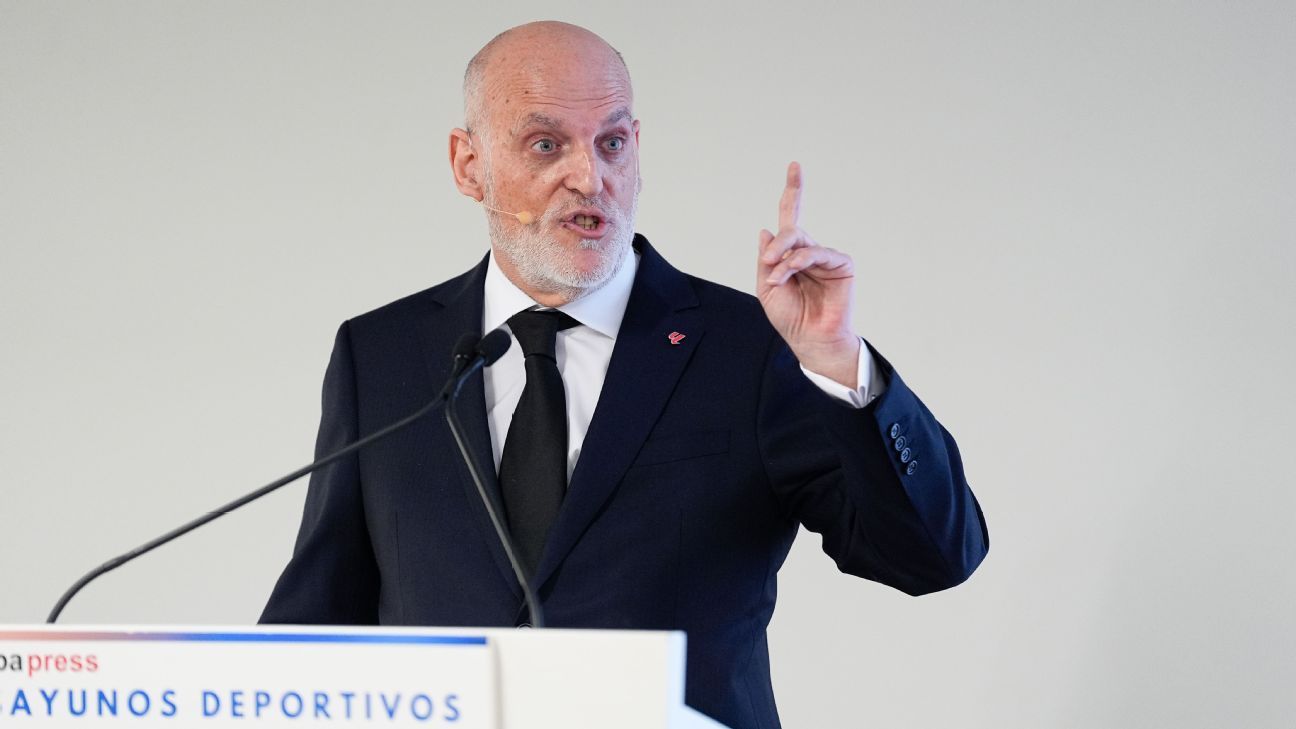
"We celebrate Halloween, which we never celebrated 20 years ago. We have NFL games. We have NBA games," Tebas said. "Let's see if 50 years from now we'll have the stadiums empty, and the ones for the NBA and the NFL full. Because they don't bring just one game, they all bring many games.
"They don't come to Europe on vacation, they come to get fans to sign television deals, to get children for their competitions. In other words, we opened the doors to Europe. Instead, the United States, which opens the doors for us to go, we close them here in Europe."
We sent them Halloween and the NFL, so now they want to bless us with their version of soccer. The logical is impeccable.
Sports is now just a giant game of Risk where instead of territory the prize is money. Tebas understands that La Liga can't afford to sit out the grand game of market capture if it wants to keep up with the likes of the Premier League.
There's no other way to put it. I hate this. Lo odio. Domestic soccer belongs in its domestic home, not in another country across an oceans staged for an stadium full of walking dollar signs. Soccer is not American football or basketball, where the predominance of a singular league (an American one) is so clearly accepted that the idea of those leagues encroaching on foreign soil with their products is not nearly as problematic. I mean, I don't love NFL games in London, but I see why they make sense.
Awhile back, at some point during my run hosting an American soccer-centric radio show appropriately named "The United States of Soccer" (R.I.P.), I settled on a very macro view of what constitutes "American soccer".
There's all of the obvious stuff, like domestic club competitions, college soccer, youth soccer, etc. The national teams fall under the heading, of course. But to go macro, you have to include anything that originates in America, even if it involves soccer played abroad.
Under that broad definition, "American soccer" is every culture, group, or fan who partakes in the any version of the game while based in this massive country of ours. Mexican soccer is American soccer, in the sense that Mexican fútbol is one of the most popular leagues with soccer-watching audiences in America.
Liga MX is a perfect example of how the tail of American interest in the product wags the dog of decision-making with those in charge. American soccer's real power doesn't lie in the growth of its domestic leagues—it lies in its importance as a market for any league with the ability to exploit it.
Executives all over are acting accordingly.
I can't speak to any other country's soccer culture, but in the United States our love of the game is best explained as collection of small bubbles, that when taken collectively amount to a significant mass.
We've got more flavors of fandom than probably anywhere else in the world because of a) the diversity of the people that make up our soccer-loving population and b) the access to the game we enjoy via television and the internet.
A love of the same game connects the people who gather every weekend for amateur men's league matches at the middle school behind my house to the people who show up at a bar on a Saturday morning to watch their beloved English Premier League team. It's all American soccer, but each of those groups are distinct bubbles that don't often interact in consequential ways.
I alluded to this idea when I wrote about the challenges MLS faces to connect with the sizable soccer audience here in America: The idea is that there are entire communities of soccer fans that are, if not inaccessible to MLS, speak such a sharply different soccer language (in the figurative sense) that they might as well be.
Here's the pertinent question for those of us who want to see MLS and domestic club soccer grow: Does La Liga, or any other league, bringing competitive matches here hurt our leagues ability to find fans?
Maybe the people who support the idea of La Liga matches being played in America reside in one of those bubbles. Maybe it won't hurt the growth of the domestic leagues if a foreign competition brings competitive matches to the United States. It's quite possible that the effect on soccer here would be negligible and soccer protectionism is reactionary and unnecessary (though FIFA's rules, which it ultimately backed away from in the face of legal challenges, exist for a reason).
That doesn't make it right. Tebas is just another in a long line of sports executives who has dropped the pretense of stewardship of the game's deepest held principles for the realities of chasing the money. There's probably no way back from here, but I don't have to like it.
There's a new episode of The Best Soccer Show out today. It's the first episode of the new era of the show as I look for people to sit in for Jared DuBois following his stepping back from the podcast. This first effort features Mitch Clark from the Enemies of the Fire podcast and Thomas Pinzone from The Blazing Musket.
I really enjoyed talking to these guys and I think the new approach on TBSS will mean more MLS talk. Check out the show. If you want to be like Mitch and Thomas and sit in on the show, drop me a line.
If you're jonesing for the Rodius, don't worry: He's likely to pop up during the World Cup months and will be doing some special content with me on our Patreon page. A couple bucks a month will get you access.
Back early next week with some thoughts on MLS Week 2. Tell a friend about Soccer Eagle.